Indoor Cultivation

Paddy Straw Mushroom: Cultivation of paddy straw mushroom using paddy straw is the oldest and commonly used technique but it gives very low mushroom yield (10-15% of dry substrate). This mushroom has the ability to grow at a higher temperature (28-35oC) It can be grown on comparatively cheaper agro-industrial wastes It is fast growing thus has very short cropping cycle (30days).

Its cultivation technology is easy . It has good acceptability at consumers’ level National Status: In India, this mushroom is cultivated under natural conditions in Orissa, West Bengal, Andhra Pradesh, Tamil Nadu and Kerala, but with low mushroom yield. International Status: It is cultivated in most of the South East Asian countries like Taiwan, Indonesia, Thailand and China. China alone produces around 6, 00, 000 tons of this mushroom annually, both for local and foreign market.

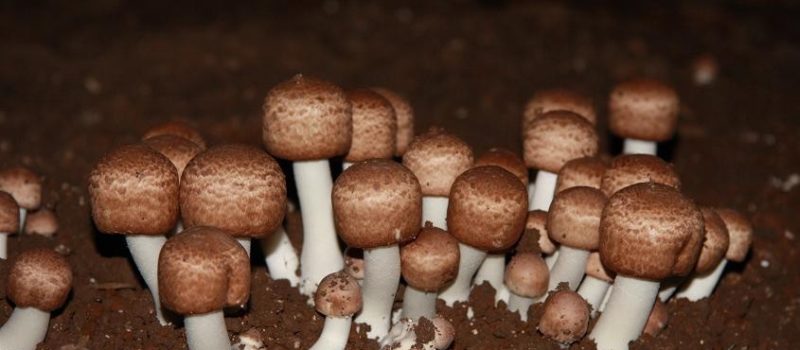
Indoor Cultivation Technology: This technology has been perfected by using paddy straw and Cotton Ginning Mill waste. It gives higher mushroom yield (35-40% biological efficiency) and has the potential to bring the cultivation of this mushroom at semi-industrialized level.

Wetting of substrate to achieve 60-65% moisture Out door composting for 4 days Filling on racks in cropping room at a thickness of 12-15cm Pasteurization on next day with in cropping room at 62-64oC for 3-4 hours Conditioning at 45-50oC for 2-3 days till complete elimination of Ammonia Cooling of substrate to bring temperature at 30-35oC and spawning Spawn run for 4-5 days at 32-35oC Removal of plastic sheets from spawned substrate and maintaining room temperature at 28-32oC, RH-80-85%, intermittent fresh air circulation and fluorescent light for 4-5 hours/day.

Starting of first flush harvest after 9-10 days of spawning Total harvesting period of 20 days Harvesting at button stage, packaging and sale of fresh produce with in one day

Coriolus 6

PhaseI/II Trial of Trametes Versicolor in Breast Cancer Patients

Extracts of the medical mushroom Trametes versicolor (Tv) are prescribed as adjunctive immune therapy for women with breast cancer in both Asia and by licensed North American naturopathic physicians. Japanese data suggest that Tv may improve survival and reduce recurrence in early stage breast cancer. While Tv is prescribed by NDs and other CAM practitioners and used with growing frequency among breast cancer patients as an over-the-counter supplement there have yet to be well-designed clinical studies in the United States. Standardized commercially available products are in wide use.

The phase I/II clinical trial of orally administered Tv is the first U.S. trial of this promising CAM adjunctive immunomodulatory cancer therapy.

Leggi tutto

Coriolus 5

Trametes Versicolor-Induced Immunopotentiation in Vivo/Ex Vivo

Mushroom products advertised as immune-enhancing agents are readily available over the counter and prescribed by licensed Naturopathic and traditional Chinese medicine practitioners in North America for cancer care. While prescription of purified mushroom actives is common, complex mushroom extracts are gaining popularity in the CAM community based on the assumption that synergy between multiple active constituents in a more complex formula enhances clinical efficacy. Well-characterized Trametes versicolor (Tv) extracts, polysaccharide-Krestin (PSK) and polysaccharopeptide (PSP), are approved drugs for cancer adjunctive immunotherapy in Asia. Many published in vitro, animal and clinical studies, most conducted in Japan or China, report immune-enhancing properties of these Β-glucan-containing protein-polysaccharide fractions that potentiate antitumor activities of neutrophils, monocytes, macrophages, NK cells and T cells. Additionally, a large body of evidence suggests purified Β-glucans isolated from fungi, yeast and cereal grains induce potent antitumor immune responses.

Leggi tutto

Coriolus 4

Trametes Versicolor-Induced Immunopotentiation in Murine Model

A number of commercially-obtained derivatives of the mushroom Trametes Versicolor (Tv) have been shown to activate the immune system in rodent models. These derivatives contain high levels of ß-glucans, which interact with a number of immune-related cell types. Subsequent industry-sponsored research into the mechanism of these products has resulted in a dearth of research into the parental whole product that contains a number of potentially immunopotentiating constituents including ergosterol-like compounds. At this juncture, the potential for synergistic action between the ß-glucan polysaccharides and the non-glucan constituents have not been investigated. Furthermore, the direct connection between quantity of TV crude extract consumption, induction of an immune response, and tumor regression/amelioration of treatment side effects remains to be explored.

We hypothesize that ß-glucan polysaccharides in Tv represent a major constituent that, when consumed orally in a murine tumor system, upregulate the immune system causing tumor regression and amelioration of therapy-induced side effects. Furthermore, we theorize that non-glucan constituents can have an additive or even synergistic effect on the stimulation of the immune response.

Leggi tutto

Coriolus 3

Data Core

Turkey Tail Mushroom The DCRC Data Core (DC) serves as the Center’s resource for providing Data Management, Data Quality Assurance, Data Processing, and Statistical Analysis for the DCRC.  The DC is housed at Bastyr University under the direction of Annette Fitzpatrick Ph.D. who works closely with the Director of the Administrative Core and the other DCRC project leaders in ensuring that all clinical data collection, management and analysis processes are of the highest quality.

The DC develops and implements Standard Operating Procedures for all data collection and management activities and provides quality assurance and control activities.  The DC also supports Dr. Standish in developing a Data Safety Monitoring Plan for the Dose Escalation trial planned for Project 3.

Data for reports to the Administrative Core, Internal and External Advisory Committees, the IRBs of the participating institutions and NCCAM is the responsibility of the DC.  Analysis of data for publications and future grant applications will also be conducted by the DC.  Both the DCRC and its component projects benefit from the services provided by the DC from project initiation with the development of data collection tools and study databases through project completion with reports to be used in manuscript development and future study designs.

Key Personnel:
Annette Fitzpatrick, Director, Bastyr University